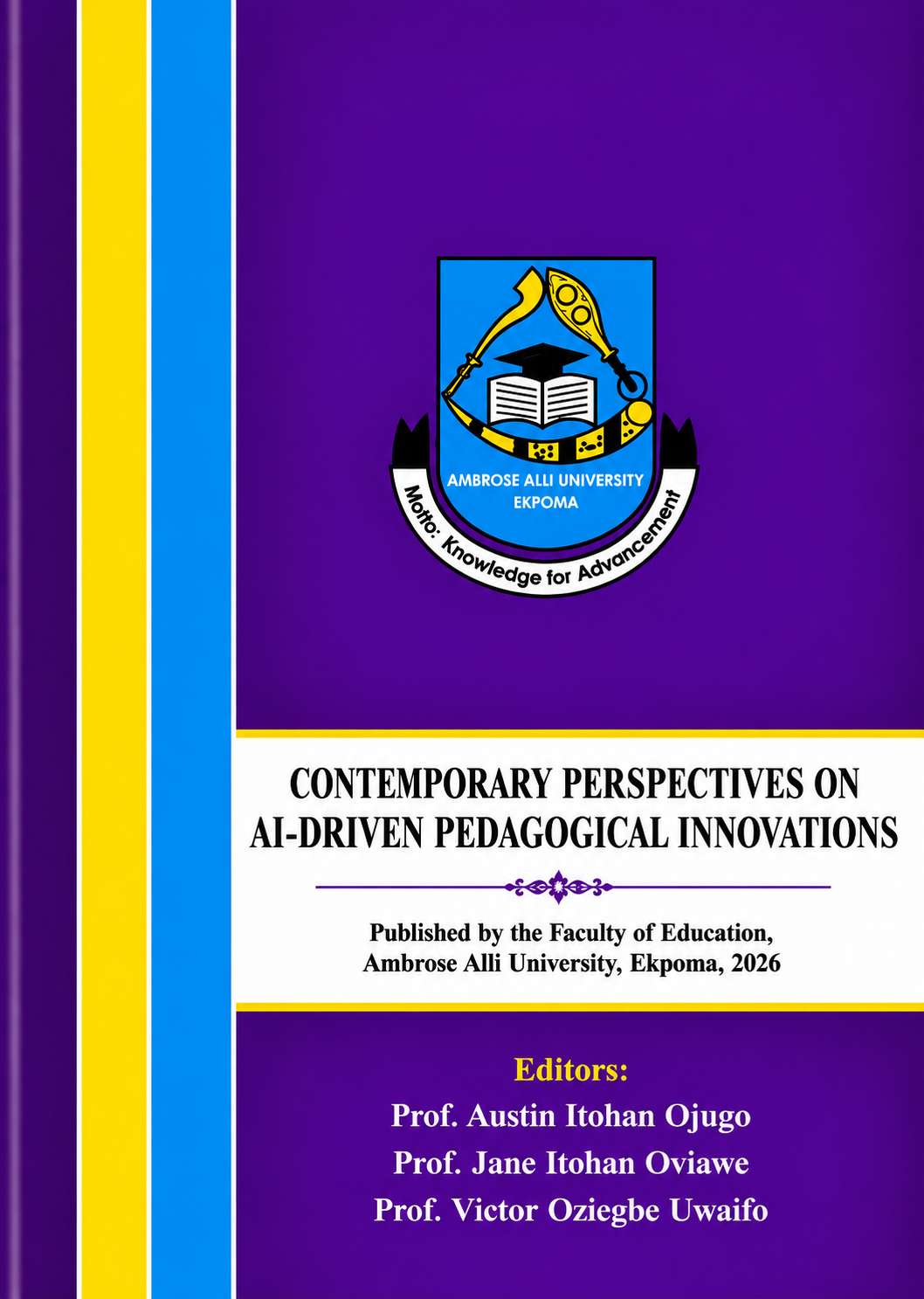
USE OF ARTIFICIAL INTELLIGENCE TECHNOLOGIES IN TRANSFORMING SCHOOL COUNSELLING SERVICES: PITFALLS/ETHICAL CONCERNS AND FUTURE DIRECTIONS
Keywords:
AI, Counselling Services, Digital Counselling, Transformative, TechnologiesAbstract
ABSTRACT
This paper examined the transformative role of AI technologies in school counselling services. It adopted a conceptual review approach. The concept of Artificial Intelligence, school counselling services, and the various AI technologies currently applicable to counselling practice explored. The paper argued that AI should complement rather than replace professional school counsellors, whose human judgment, empathy, ethical reasoning, and interpersonal skills remain indispensable. It concluded that the future of school counselling lies in the effective collaboration between human expertise and artificial intelligence, thereby promoting more inclusive, accessible, and responsive counselling services in the digital age. The paper therefore suggested the development of comprehensive ethical guidelines, AI literacy programmes for counsellors, improved digital infrastructure, robust data protection frameworks, and continuous professional development to facilitate the responsible adoption of AI in counselling practice.
References
## REFERENCES
Abd-Alrazaq, A. A., Alajlani, M., Alalwan, A. A., Bewick, B. M., Gardner, P., & Househ, M. (2020). An overview of the features of chatbots in mental health: A scoping review. *International Journal of Medical Informatics, 132*, 103978.
American School Counselor Association. (2022). *The ASCA national model: A framework for school counseling programs* (4th ed.).
Davis, F. D. (1989). Perceived usefulness, ease of use, and user acceptance of information technology. *MIS Quarterly, 13*(3), 319–340.
European Commission. (2021). *Proposal for a regulation laying down harmonized rules on artificial intelligence (Artificial Intelligence Act)*. Publications Office of the European Union.
Fitzpatrick, K. K., Darcy, A., & Vierhile, M. (2017). Delivering cognitive behaviour therapy to young adults with symptoms of depression and anxiety using an automated conversational agent. *JMIR Mental Health, 4*(2), e19.
Floridi, L., & Cowls, J. (2019). A unified framework of five principles for AI in society. *Harvard Data Science Review, 1*(1). https://doi.org/10.1162/99608f92.8cd550d1
Goodfellow, I., Bengio, Y., & Courville, A. (2016). *Deep learning*. MIT Press.
Gysbers, N. C., & Henderson, P. (2014). *Developing and managing your school guidance and counseling program* (5th ed.). American Counseling Association.
Holmes, W., Bialik, M., & Fadel, C. (2022). *Artificial intelligence in education: Promises and implications for teaching and learning*. Center for Curriculum Redesign.
Ifenthaler, D., & Yau, J. Y.-K. (2020). Utilizing learning analytics to support study success in higher education: A systematic review. *Educational Technology Research and Development, 68*(4), 1961–1990. https://doi.org/10.1007/s11423-020-09788-z
Inkster, B., Sarda, S., & Subramanian, V. (2018). An empathy-driven conversational artificial intelligence agent (Wysa) for digital mental well-being. *JMIR mHealth and uHealth, 6*(11), e12106. https://doi.org/10.2196/12106
Jurafsky, D., & Martin, J. H. (2023). *Speech and language processing* (3rd ed.). Pearson.
Kaplan, A., & Haenlein, M. (2020). Rulers of the world, unite! The challenges and opportunities of artificial intelligence. *Business Horizons, 63*(1), 37–50.
Kaur, D., Uslu, S., Rittichier, K. J., & Durresi, A. (2023). Trustworthy artificial intelligence: A review. *ACM Computing Surveys, 56*(2), Article 39.
Luckin, R. (2018). *Machine learning and human intelligence: The future of education for the 21st century*. UCL Institute of Education Press.
Marakas, G. M. (2003). *Decision support systems in the 21st century* (2nd ed.). Prentice Hall.
Myrick, R. D. (2011). *Developmental guidance and counseling: A practical approach* (5th ed.). Educational Media Corporation.
OECD. (2021). *Digital education outlook 2021: Pushing the frontiers with AI, blockchain and robots*. OECD Publishing.
OpenAI. (2023). *GPT-4 technical report*. *arXiv*. https://doi.org/10.48550/arXiv.2303.08774
Power, D. J. (2002). *Decision support systems: Concepts and resources for managers*. Greenwood Publishing Group.
Rogers, C. R. (1957). The necessary and sufficient conditions of therapeutic personality change. *Journal of Consulting Psychology, 21*(2), 95–103.
Rogers, E. M. (2003). *Diffusion of innovations* (5th ed.). Free Press.
Romero, C., & Ventura, S. (2020). Educational data mining and learning analytics: An updated survey. *WIREs Data Mining and Knowledge Discovery, 10*(3), e1355. https://doi.org/10.1002/widm.1355
Russell, S., & Norvig, P. (2021). *Artificial intelligence: A modern approach* (4th ed.). Pearson.
Siemens, G., & Baker, R. S. (2012). Learning analytics and educational data mining: Towards communication and collaboration. In *Proceedings of the 2nd International Conference on Learning Analytics and Knowledge* (pp. 252–254). Association for Computing Machinery. https://doi.org/10.1145/2330601.2330661
Siemens, G., & Long, P. (2011). Penetrating the fog: Analytics in learning and education. *EDUCAUSE Review, 46*(5), 30–40.
Stone, C. (2013). *School counseling principles: Ethics and law* (3rd ed.). American School Counselor Association.
UNESCO. (2023). *Guidance for generative AI in education and research*. UNESCO.
Venkatesh, V., & Davis, F. D. (2000). A theoretical extension of the Technology Acceptance Model: Four longitudinal field studies. *Management Science, 46*(2), 186–204. https://doi.org/10.1287/mnsc.46.2.186.11926
Venkatesh, V., Morris, M. G., Davis, G. B., & Davis, F. D. (2003). User acceptance of information technology: Toward a unified view. *MIS Quarterly, 27*(3), 425–478. https://doi.org/10.2307/30036540
Downloads
Published
Issue
Section
License
Copyright (c) 2026 STUDIES IN EDUCATION

This work is licensed under a Creative Commons Attribution-NonCommercial 4.0 International License.